
Every fall, maintenance shutdowns bring back the same horror stories: the flange that leaks on start-up, the bolt that lets go, the schedule that overruns. For Halloween, we gave them monster faces. But behind every monster there is a measured fact, and almost always the same cause: poorly controlled bolt preload.
The fact that explains everything else: roughly 90% of applied torque is lost to friction: 50% under the bolt head or nut and 40% in the threads, according to standard reference data on bolted joints. Only 10% actually stretches the bolt. Here are the 9 stories, and how each one can end well.
1. The Bride of Flangenstein: the flange leak

The monster: an eye glowing in the steam, right as the unit restarts.
The real fact: in its 2026 series on the ASME PCC-1 standard, HYTORC describes bolt preload as the single most important factor in preventing flange leaks. Misalignment “fixed” by tightening harder and uneven lubrication complete the picture.
How it ends well:
- inspect flange faces and the gasket before tightening;
- align the piping first, never with the bolts;
- lubricate every stud with the same product;
- tighten in cross-pattern passes up to the target torque.
2. A torque from hell… when it’s controlled
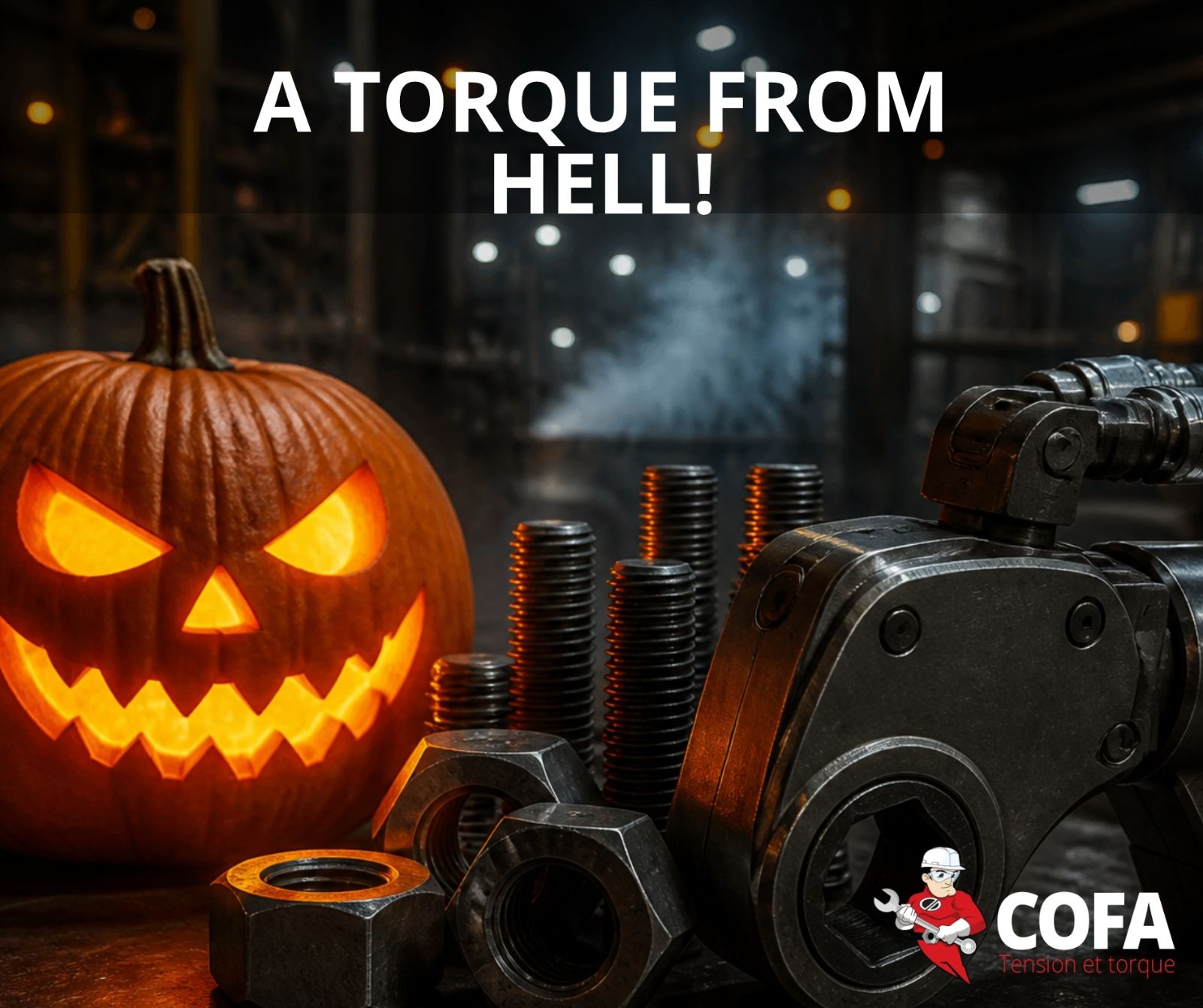
The monster: the grinning pumpkin, while two neighbouring bolts carry completely different tension.
The real fact: with a torque wrench, preload uncertainty ranges from ±25% on lubricated bolts to ±35% on dry bolts, according to reference tables drawn from Bickford. In other words, on the same flange, one bolt can carry nearly twice the load of its neighbour.
How it ends well: the same lubricant everywhere, a calibrated tool, and a value taken from a real chart. Our article on reading a HYTORC torque chart walks through the pressure-to-torque conversion step by step.
3. Tight… but not like a mummy
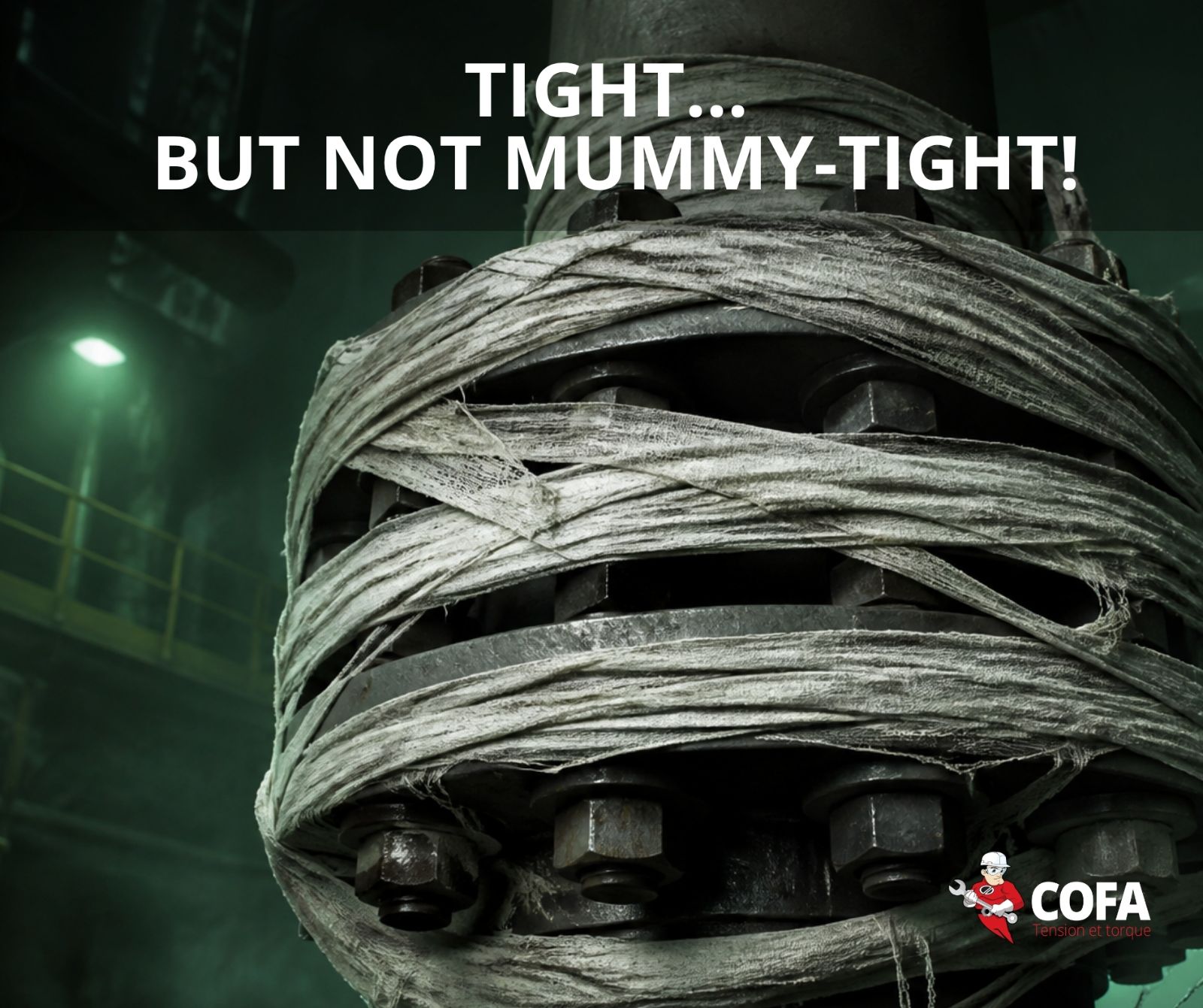
The monster: the wrapped-up flange someone tightened “just a little more, to be safe”.
The real fact: tighter is not safer. HYTORC points out that target preload generally sits between 50% and 70% of the bolt’s yield strength. Beyond that, you crush the gasket or permanently stretch the stud, and the leak comes back at the first thermal cycle.
How it ends well: calculate the torque from the target load (T = K × D × F), then stick to it. The safety margin is already built into the calculation.
4. A badly tightened bolt always comes back to haunt you
The monster: the nut that unscrews itself, with nobody touching it.
The real fact: it’s not a ghost. In 1969, German engineer Gerhard Junker showed that transverse vibration loosens a bolted joint on its own. His test became a reference, standardized in DIN 65151 among others. Loosening starts when the clamped parts slip against each other, and sufficient preload is what keeps them from slipping.
How it ends well: hit the right preload on the first pass on equipment that vibrates: pumps, crushers, conveyors, heavy machinery.
5. The abandoned bolt: the invisible enemy
The monster: a shadow growing behind a bolt tightened last week.
The real fact: a bolt loses tension after tightening, even when the job is done right. Bickford’s measurements on structural steel show 11% loss right after tightening, then another 3.6% over 21 days. Southwest Research Institute measured an average 5% immediate loss. Sheet gaskets such as graphite or PTFE make it worse: the gasket slowly squeezes down under load, the bolt relaxes and loses even more tension.
How it ends well: plan a check pass. With sheet gaskets, let the joint settle for a while, then run another pass at the target torque.
6. Strange noises at night? Check your flanges

The monster: a hiss in the piping when the plant is empty.
The real fact: heat is a real witch. According to Brown and Lim’s tests, at 385 °C (725 °F), B7 studs lose about 60% of their preload, versus about 25% for B16 studs. A flange that held tight when cold can start talking after the first heat-up.
How it ends well: choose the stud grade for the service temperature, and inspect critical flanges after the first heating cycle.
7. The wrong tool… is a bad spell
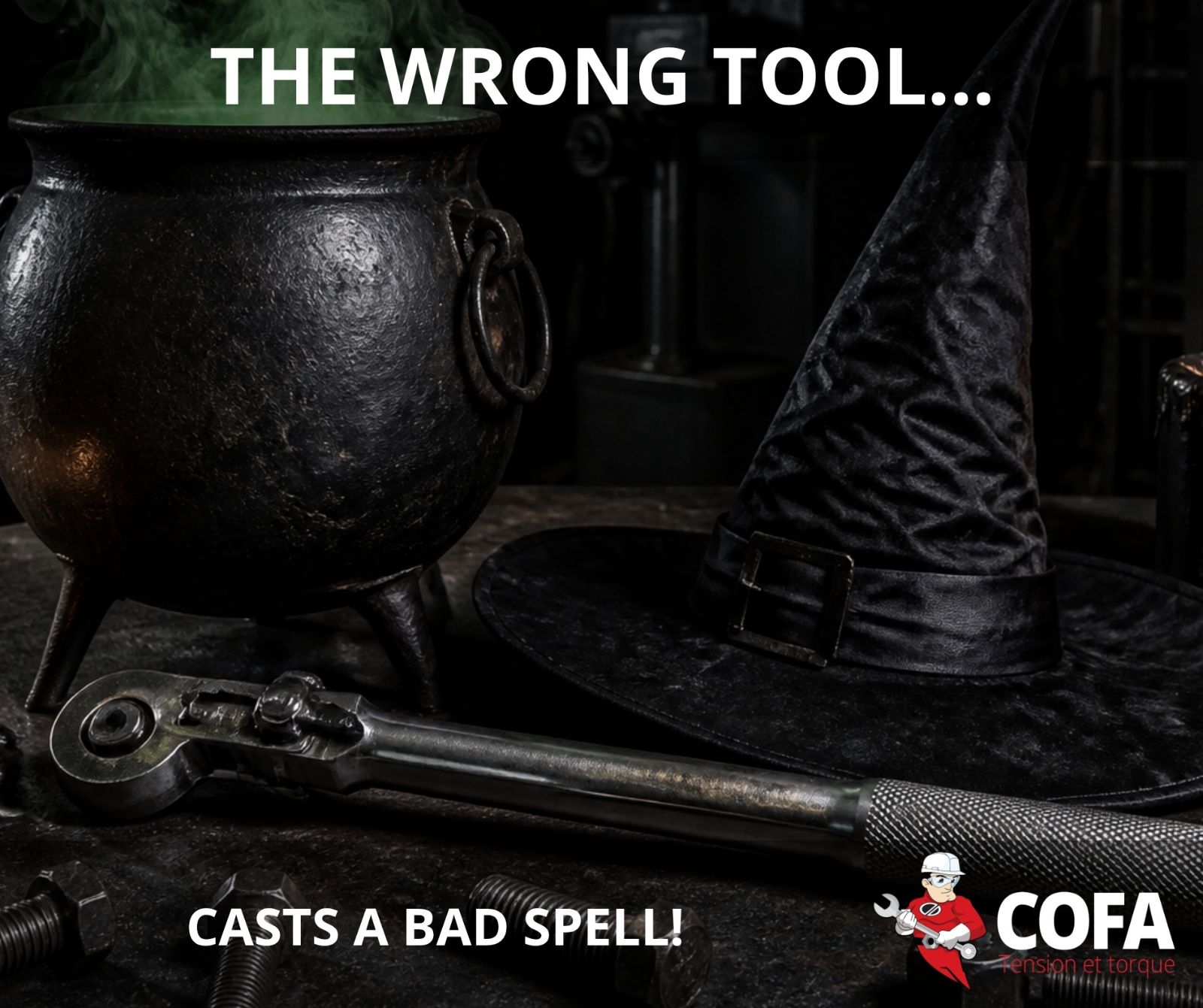
The monster: the old impact wrench pulled out of the truck “because it was there”.
The real fact: an impact wrench hammers; it measures nothing. Even with a manual torque wrench, preload uncertainty can reach ±35%, and the result depends heavily on the operator. A controlled bolting tool, hydraulic or electric, applies a set, repeatable value.
How it ends well: book the right tool before the shutdown. Our electric bolting tools and our bolting tool rental service are built for exactly that.
8. No ghosts in your bolting data

The monster: the “I think it was tightened” haunting the shutdown report.
The real fact: a bolting tool is a measuring instrument. ISO 6789 sets a default recalibration interval of 5,000 cycles or 12 months, and immediately after an overload of 25% or more. Recent electric tools such as the HYTORC LION GUN X also log every tightening.
How it ends well: an up-to-date register (tool, serial number, value, date) and a valid certificate. Our article on how often to calibrate bolting tools details what a useful certificate contains.
9. A bleeding budget… beware of vampires

The monster: the shutdown that runs three days over, and the invoice that follows.
The real fact: according to Siemens’ The True Cost of Downtime 2024 report, unplanned downtime costs the world’s 500 largest companies 11% of their revenue. In heavy industry, a typical plant loses US$59 million a year to it, and the cost of an hour of downtime has quadrupled since 2019.
How it ends well: plan the bolting before the shutdown. Tools booked, calibrated and delivered with their charts on day 1: that’s the garlic against this vampire.
Why does a flange leak even when tightened to the specified torque?
Because torque is not load. About 90% of torque is lost to friction, and that friction varies from stud to stud with lubrication and thread condition. Two bolts tightened to the same torque can therefore carry very different loads. Controlled tightening, in cross-pattern passes, narrows that gap.
How much preload does a bolt lose after tightening?
Published measurements range from 5% to 11% right after tightening, according to Southwest Research Institute and Bickford. Sheet gaskets lose more because they slowly squeeze down under load. At high temperature, the loss can exceed half the preload. Hence the value of a check pass.
How often should a torque wrench be calibrated?
ISO 6789 sets a default recalibration interval of 5,000 cycles or 12 months, whichever comes first, and immediately after an overload of 25% or more. A company’s internal procedures can set a shorter interval for the most heavily used tools.
The right torque isn’t witchcraft
All 9 stories share the same cause: tightening that isn’t controlled. They also share the same cure: the right torque, a calibrated tool, bolt by bolt. Shutdown coming up? Contact our team and we’ll help you prepare the tools, the charts and the calibration of your fleet before day 1.
Sources
- Wikipedia, Bolted joint (torque, friction and accuracy of tightening methods)
- HYTORC, ASME PCC-1 Flange Assembly Series, Part 1 (2026)
- J. H. Bickford, Introduction to the Design and Behavior of Bolted Joints, CRC Press (2008)
- Junker test, after G. Junker, SAE Transactions (1969)
- ISO, ISO 6789-2:2017, Assembly tools for screws and nuts: hand torque tools (2017)
- Siemens, The True Cost of Downtime 2024 (2024)
Talk to an expert now!
Give us a call. We are friendly, too. 1-844-266-2632 or send us a note.

